
Why Did My Credit Card Processing Fees Go Up?
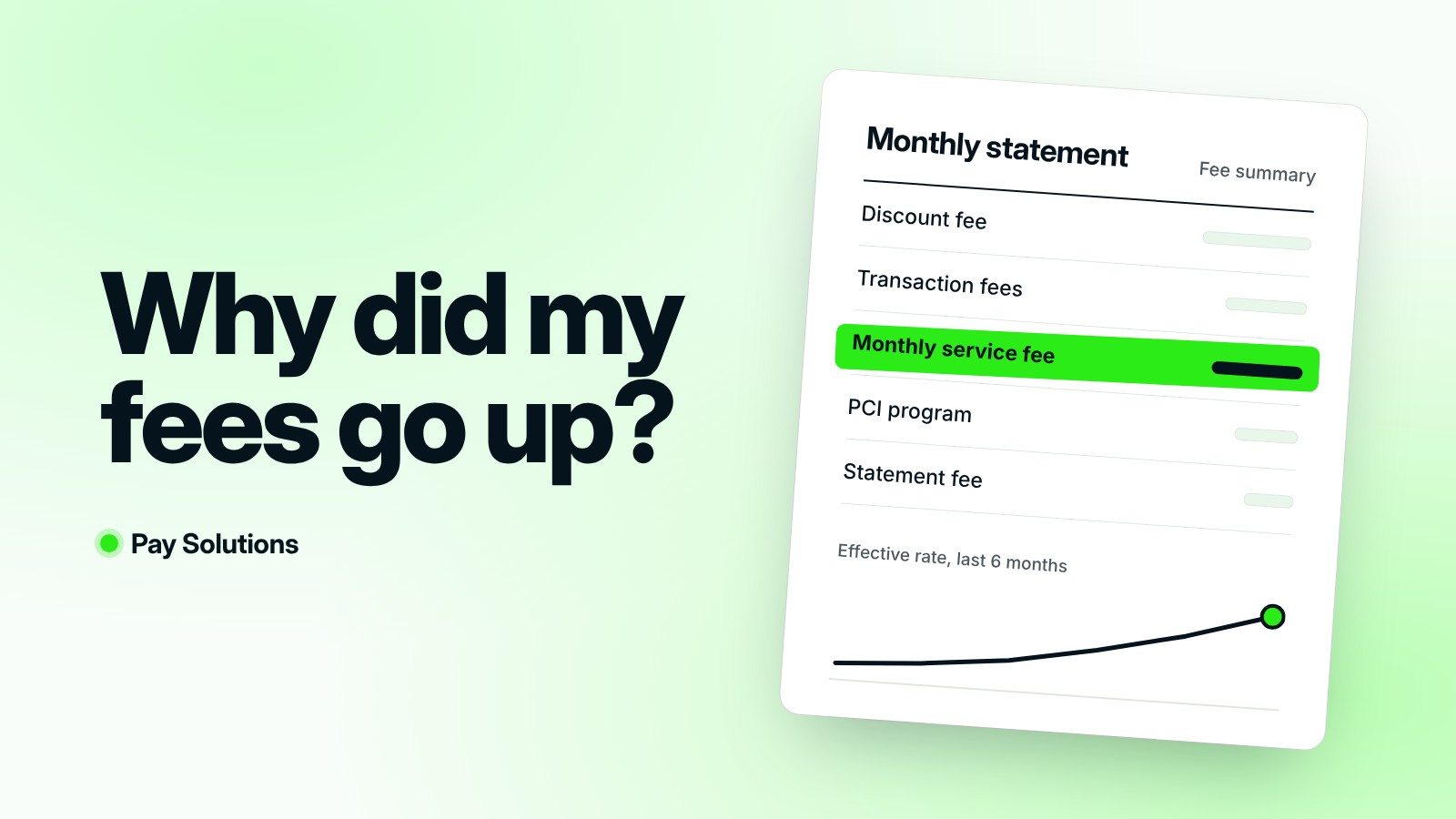
Higher processing fees this month? Here are the most common reasons fees go up, how to spot each one on your statement, and what you can do about it.
You open your merchant statement and the fees are higher than last month. Your prices didn't change, nobody called you, and the statement doesn't explain why. So what happened?
There's almost always a reason, and you can usually find it. It just isn't printed in plain English. Below are the most common reasons processing fees go up, where to look for each one on your statement, and what to do about it.
First, Make Sure Your Fees Actually Went Up
Before you pick up the phone, check that you're comparing the right numbers. If you ran more card sales this month, your total fees went up too. That's normal and doesn't mean anything changed.
The number that matters is your effective rate: your total processing fees divided by your total card sales for the month. It tells you what you're really paying per dollar, no matter what rate you were quoted.
Pull your last three to six statements and work out the effective rate for each month. Our fee calculator can help. If that number is creeping up, something changed, and one of the reasons below is the likely cause.
1. Your Processor Raised Its Markup
Every processing fee has two parts: the wholesale cost set by the card brands and issuing banks, and your processor's markup on top. The markup is the part your processor controls.
Many processing agreements allow pricing changes with notice. That notice is often a short message printed on your statement, easy to skip if you only look at the total.
Where to look: the "messages" or "notices" section of your statement, plus the percentage and per-transaction fees in the fee summary. Compare them to an older statement.
2. A New Fee Showed Up
Sometimes the rate stays the same and a new line item appears instead. Common examples include monthly service fees, statement fees, annual fees, and charges labeled "regulatory," "compliance," or "network." Each one may look small, but together they can move your effective rate noticeably.
Where to look: compare the fee section of this month's statement line by line against one from six months ago. If you're not sure what a line item means, our guide on how to read your merchant statement breaks down the usual sections, and our post on hidden processing fees covers the ones that tend to slip in quietly.
3. You're Being Charged a PCI Non-Compliance Fee
Businesses that accept cards are expected to validate their PCI compliance, usually through a yearly self-assessment questionnaire. If that lapses, many processors add a monthly non-compliance fee until it's done.
This one often surprises owners because nothing about the business changed. A renewal deadline simply passed.
Where to look: a line item mentioning "PCI," "non-compliance," or "non-validation." The fix is usually completing the questionnaire, so ask your processor how.
4. Your Introductory Pricing Ended
Some accounts start with promotional pricing or waived fees for a set period. When that period ends, the regular pricing kicks in, sometimes with no reminder.
Where to look: your original application or agreement, for anything mentioning a promotional period or waived fees.
5. The Card Brands Changed Their Wholesale Costs
Visa, Mastercard, and the other networks periodically update interchange (the wholesale cost paid to the card-issuing bank) and their own assessment fees. These changes affect every processor.
How they reach you depends on your pricing model. On interchange-plus pricing, wholesale changes pass through directly and stay visible on your statement. On tiered or flat-rate pricing, the wholesale cost is bundled into your rate, so it's hard to tell how much of an increase came from the card brands and how much came from your processor.
6. Your Customers Are Paying With Different Cards
Not all cards cost the same to accept. Rewards credit cards and business or corporate cards generally cost more than basic debit cards. If your customer mix shifts, your costs shift with it. That might mean more business clients, a holiday season heavy on rewards cards, or fewer debit customers.
On tiered pricing, this often shows up as more transactions falling into the more expensive "mid-qualified" or "non-qualified" buckets.
Where to look: the card-type or qualification breakdown on your statement.
What to Do About It
Once you know the likely cause, here's how to handle it:
- Gather your statements. Three to six months gives you a clear trend.
- Track your effective rate. It's the simplest way to see the real cost over time.
- List anything new. New line items, changed rates, and any notices in the messages section.
- Call your processor with specific questions. Ask what changed, when, and why, and whether it can be reversed. Specific questions get better answers than "why is my bill high?"
- Read your agreement before switching. Look for how pricing changes are handled and whether an early termination fee applies.
- Look at your pricing structure. Interchange-plus pricing makes it easier to see what comes from the card brands versus your processor. Some businesses also use cash discount, dual pricing, or surcharging programs to offset card costs. Rules for these vary by state and card brand, so learn them before you start. Our guide to dual pricing vs. cash discount explains the differences.
Frequently Asked Questions
Can my processor raise my fees without telling me?
It depends on your agreement. Many agreements allow pricing changes with notice, and that notice may be a message on your statement rather than a phone call or letter. Check your contract and read the messages section of every statement.
Why do my fees change every month if my rate stayed the same?
Your total fees move with your sales volume, number of transactions, card mix, and how cards are accepted (tapped versus keyed, for example). Fixed monthly fees also take up a bigger share of your sales in slower months. That's why your effective rate is a better gauge than your total.
Is it worth switching processors over a fee increase?
Sometimes, but compare the full picture first: effective rate, monthly fees, contract terms, equipment, and any early termination fee. A lower quoted rate doesn't always mean a lower bill.
Will a surcharge or cash discount program stop my fees from going up?
No. These programs don't change what your processor charges you. They change who covers part of that cost. Rules vary by state and card brand, so make sure any program is set up correctly before you offer it.
Not Sure What Changed? Let Us Take a Look
Statements are hard to decode, and you have a business to run. Send us a recent statement through our free statement analysis. We'll show you what you're actually paying, point out what changed, and tell you whether there's room to do better.
Want a quick gut check first? Try our fee calculator to see your effective rate.
Seona, LLC. is a registered Independent Sales Organization of Pathward, N.A. Bank, Sioux Falls, SD.